Christine Ferguson
My experience with you was fantastic and easy to navigate. I'm looking forward to taking the course.
 Lifetime Access
Python Programming for Data Analysis Overview In today’s data-driven world, understanding how to analyze and interpret data is…
Access to 1500+ Courses with free CPD Certificates for Only £99 Get Now
In today’s data-driven world, understanding how to analyze and interpret data is an invaluable skill. Python Programming for Data Analysis is a comprehensive course designed to equip you with the programming prowess and analytical techniques necessary to handle real-world data challenges. This course guides you from the basics of Python to advanced data analysis and visualization, ensuring you gain both theoretical knowledge and practical expertise. Whether you aim to become a full-fledged data analyst, a data-driven decision-maker, or a curious individual looking to understand data science, this course lays a strong foundation and opens up exciting opportunities in the rapidly growing field of data analytics.
This hands-on course takes students on a learning journey from the fundamental concepts of Python to the core practices of data analysis. The curriculum is carefully structured to ensure both novices and those with some programming experience can follow along and extract maximum benefit.
You will start by mastering the syntax and structure of Python, including variables, data types, functions, and control flow. Building on this foundation, you will learn how to work with essential data structures like lists, dictionaries, and sets, as well as how to manipulate files and work with external datasets.
The course then transitions to introduce some of the most widely used data analysis libraries in Python, such as Pandas for data manipulation and cleaning, NumPy for numerical computation, and Matplotlib and Seaborn for effective data visualization. You will work with real-world data sets, gaining expertise in data wrangling, cleaning, transforming, and analyzing data to extract actionable insights.
Additionally, you will learn how to handle missing or inconsistent data, preprocess for quality analysis, and generate informative plots to visualize trends, distributions, and patterns. Special emphasis will be placed on exploratory data analysis (EDA), empowering you to ask the right questions and use the right tools for comprehensive data exploration. The final project will synthesize all skills learned by having you complete an end-to-end data analysis on a publicly available dataset.
Throughout the course, a mix of theory, practical exercises, quizzes, and projects ensure you can apply your learning immediately. All lessons will be delivered through high-quality video lectures, supplemented by Jupyter notebooks and interactive coding challenges. The course aims to demystify data analysis and make Python an accessible and empowering tool for all learners.
The skills acquired in this course unlock a wide range of career possibilities in domains where data analysis is crucial. Python is currently the most popular language among data professionals due to its flexibility and robust collection of libraries.
Graduates of this course will be well-prepared for entry-level positions in data analysis or data science, and will possess the foundational knowledge required for advanced studies in data science, machine learning, and related fields. The Python programming skills you learn are also transferable to many adjacent areas in tech, providing a versatile and future-proof skill set.
No previous experience with programming or statistics is required—just curiosity and a willingness to learn. The course is intentionally beginner-friendly, but also comprehensive enough to benefit self-taught programmers or Excel users looking to switch to Python.
All tools used in the course (Python, Jupyter, Pandas, etc.) are open-source and freely available. Installation guides and setup support will be provided at the start of the course.
My experience with you was fantastic and easy to navigate. I'm looking forward to taking the course.
Provided highly informative and helpful responses, with quick and efficient replies.
The course selection is broad, engaging, easy to follow, and offers a good challenge.
Excellent course with user-friendly website navigation, making it easy to follow. I'm really enjoying the experience.
Great course with valuable information. Easy to follow, and I appreciated the flexibility to work at my own pace.



Once you complete your purchase, you’ll receive access to your course through your Upskilling Academy account. You can log in and access your learning materials online at any time.
Your access period depends on the course and the package you purchase. Please check the course details or your order information for the applicable access period.
Yes. Upskilling Academy courses are designed to provide flexible online learning, allowing you to study at a pace that suits your schedule.
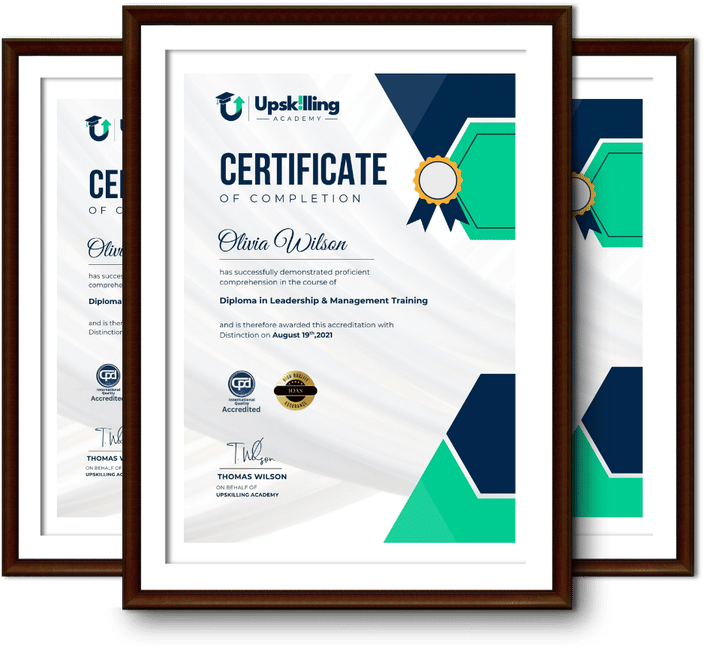
Certificate availability varies by course. Where a certificate is included, you’ll receive information about the requirements and how to obtain it within the course or upon completion.
Many courses are suitable for beginners, while others may assume some previous knowledge. Please review the individual course description for information about the recommended level and prerequisites.