Upskilling Academy
Trusted by 3 million learners 24/7 online training Money back guarantee Fully accredited courses
Lean Six Sigma Level 3 Course Thumbnail Lifetime Access
Sale

Lean Six Sigma Level 3 Course

Lean Six Sigma Overview Lean Six Sigma is a globally recognized methodology that combines the principles of Lean…

Best Seller Limited Time Offer
Last Updated 18 Sep 2026 352 Enrolled English Flexible Schedule

Access to 1500+ Courses with free CPD Certificates for Only £99 Get Now

What you will learn

  • - Improve process efficiency and reduce waste in your organization
  • - Gain skills to solve problems and make data-driven decisions
  • - Boost your career opportunities with a recognized certification
  • - Learn tools and techniques used by top companies worldwide
  • - Enhance customer satisfaction by delivering consistent quality
  • - Increase your value as a team member or leader
  • - Experience practical, real-world applications of Lean Six Sigma methods

Description

Lean Six Sigma

Overview

Lean Six Sigma is a globally recognized methodology that combines the principles of Lean and Six Sigma to drive operational excellence and continuous improvement within organizations. The Lean Six Sigma course is meticulously designed to provide participants with a solid foundation in process improvement, waste reduction, and quality management. Through a dynamic blend of theoretical frameworks and practical applications, learners will explore critical tools and techniques aimed at increasing efficiency, reducing variations, and enhancing value delivery across industries.

With a comprehensive curriculum covering Lean methods, Six Sigma tools, and change management strategies, this course empowers professionals to not only identify and solve operational challenges but also to lead transformation initiatives at any organizational level. Graduates of this course will possess a unique skill set highly valued in diverse sectors, from manufacturing and healthcare to finance and technology.

Description

The Lean Six Sigma course offers a robust learning experience suitable for individuals seeking to master process improvement and quality control methodologies. The course is structured to follow the traditional DMAIC (Define, Measure, Analyze, Improve, Control) problem-solving framework, ensuring participants can methodically tackle business challenges and implement sustainable solutions.

Key topics covered include:

  • Foundations of Lean and Six Sigma: An introduction to the history, principles, and synergy between Lean and Six Sigma approaches.
  • Process Mapping & Measurement: Tools for visualizing processes, collecting relevant data, and establishing performance metrics.
  • Root Cause Analysis: Techniques such as the 5 Whys, Fishbone Diagrams, and Failure Mode and Effects Analysis (FMEA) to dig deep into problem genesis.
  • Lean Tools: Learning about 5S, Value Stream Mapping, Kanban, and Kaizen to achieve process efficiency and waste minimization.
  • Six Sigma Tools: Statistical Process Control, Process Capability Analysis, and other key quality management tools.
  • Implementation & Change Management: Strategies for successful project deployment and fostering a continuous improvement culture.

Throughout the course, real-world case studies and interactive assignments enable learners to apply methodologies in authentic business scenarios. Participants will have the opportunity to collaborate in project teams, model key concepts using simulation tools, and deliver a process improvement project as a capstone assignment.

Career Path

Mastery of Lean Six Sigma methodologies opens up a diverse array of career opportunities and advancement prospects. Professionals who complete this course are equipped to take on pivotal roles across various sectors, primarily focusing on process optimization, quality management, and organizational transformation.

Potential career paths include:

  • Lean Six Sigma Analyst or Consultant: Advising organizations on how to map, analyze, and optimize processes using Lean Six Sigma tools.
  • Process Improvement Specialist: Leading initiatives aimed at increasing efficiency, reducing costs, and improving product or service quality.
  • Quality Assurance Manager: Overseeing quality control activities and ensuring processes meet internal and external standards.
  • Operations Manager: Managing daily operations while driving continuous improvement and operational excellence initiatives.
  • Project Manager: Applying Lean Six Sigma methodologies to control project scope, reduce risks, and ensure timely delivery.

Individuals with Lean Six Sigma certification often pursue industry-recognized credentials such as Yellow Belt, Green Belt, Black Belt, or Master Black Belt, further enhancing their value in the job market. Graduates are positioned to work in industries such as manufacturing, healthcare, logistics, IT, retail, finance, and more.

Who Is This Course For?

The Lean Six Sigma course is ideal for a wide range of learners interested in building expertise in process improvement and quality management. Typical participants include:

  • Professionals in operations, manufacturing, quality assurance, or supply chain management seeking to enhance their skillset.
  • Managers, supervisors, and team leads aiming to implement continuous improvement initiatives in their departments.
  • Project managers and business analysts looking for structured methodologies to solve complex problems.
  • Consultants and entrepreneurs wanting to optimize business processes for greater efficiency and competitiveness.
  • Recent graduates or career changers aspiring to enter fields where process improvement is a critical function.

No matter your background, if you are driven to make meaningful changes in organizational processes and are committed to achieving high standards of quality and efficiency, this course provides a transformative learning experience.

Requirements

To ensure that all participants can fully benefit from the Lean Six Sigma course, the following prerequisites are recommended:

  • Basic Understanding of Business Processes: A foundational knowledge of how organizations operate and deliver value is beneficial.
  • Analytical Mindset: Comfort with critical thinking, data interpretation, and basic problem-solving will aid in mastering key concepts.
  • Mathematical Literacy: Familiarity with simple statistics (mean, median, mode, percentages) is helpful, though advanced statistical knowledge is not required at the entry level.
  • Computer Literacy: Ability to use productivity software such as spreadsheets and presentation tools.
  • Commitment to Learning: Willingness to participate in team activities, complete assignments, and apply concepts to real-world situations.

There are no strict educational or professional prerequisites for enrolling in this course, making it accessible to motivated learners from varied backgrounds. However, those aspiring to pursue higher-level Lean Six Sigma certifications may wish to build experience by participating in relevant projects or teams during or after the course.

Course Curriculum

Course Content

Lean Six Sigma_Module 1 – Introduction to Six Sigma

  • Lean Six Sigma_Lesson 1 – Introduction to Six Sigma

Lean Six Sigma_Module 10 – Project Management

Lean Six Sigma_Module 2 – Basic Six Sigma Concepts

Lean Six Sigma_Module 3 – The Define Phase

Lean Six Sigma_Module 4 – The Measure Phase

Lean Six Sigma_Module 5 – Analyse Phase

Lean Six Sigma_Module 6 – Improve Phase

Lean Six Sigma_Module 7 – Control Phase

Lean Six Sigma_Module 8 – Beginner Statistics

Lean Six Sigma_Module 9 – Six Sigma in Professional Field

Who should take the course

  • - Professionals seeking to improve business processes
  • - Managers aiming to enhance team performance
  • - Quality control specialists wanting to reduce errors
  • - Project leaders responsible for operational efficiency
  • - Employees interested in data-driven problem solving
  • - Engineers looking to optimize production systems
  • - Students preparing for careers in process improvement

Certificate for Success at Every Step

  • No expiry date. You can keep and use the certificate forever.
  • Recognised across various UK industries.
  • Increases your chances of employability.
  • Boosts your professional credibility.
  • Shows you're up to date with industry knowledge.
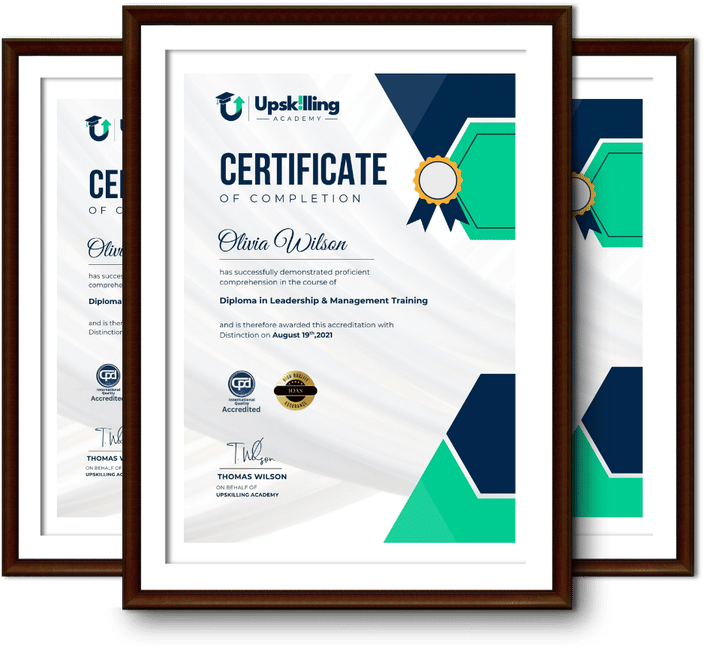
Framed Upskilling Academy certificates of completion

Course Reviews

Christine Ferguson

My experience with you was fantastic and easy to navigate. I'm looking forward to taking the course.

Jesse Harding

Provided highly informative and helpful responses, with quick and efficient replies.

Gary Schwartz

The course selection is broad, engaging, easy to follow, and offers a good challenge.

Bailey Burrows

Excellent course with user-friendly website navigation, making it easy to follow. I'm really enjoying the experience.

Benjamin Moreno

Great course with valuable information. Easy to follow, and I appreciated the flexibility to work at my own pace.

Quality Accreditation

  • incensu Registered Education Supplier
  • Association of Healthcare Trainers member
  • The CPD Group approved provider #790985
  • Disability Confident Committed

FAQ for Lean Six Sigma Level 3 Course

How do I access my course?

Once you complete your purchase, you’ll receive access to your course through your Upskilling Academy account. You can log in and access your learning materials online at any time.

How long do I have access to the course?

Your access period depends on the course and the package you purchase. Please check the course details or your order information for the applicable access period.

Can I study at my own pace?

Yes. Upskilling Academy courses are designed to provide flexible online learning, allowing you to study at a pace that suits your schedule.

Will I receive a certificate?

Certificate availability varies by course. Where a certificate is included, you’ll receive information about the requirements and how to obtain it within the course or upon completion.

Are the courses suitable for beginners?

Many courses are suitable for beginners, while others may assume some previous knowledge. Please review the individual course description for information about the recommended level and prerequisites.