Upskilling Academy
Trusted by 3 million learners 24/7 online training Money back guarantee Fully accredited courses
Level 3 Certificate in AI for Finance Thumbnail Lifetime Access
Sale

Level 3 Certificate in AI for Finance

AI for Finance Overview The rapid evolution of artificial intelligence (AI) is revolutionizing the finance industry, empowering professionals…

Best Seller Limited Time Offer
Last Updated 09 Oct 2026 352 Enrolled English Flexible Schedule

Access to 1500+ Courses with free CPD Certificates for Only £99 Get Now

What you will learn

  • - Gain practical skills to apply AI tools and techniques directly to financial analysis and decision-making
  • - Learn to detect fraud, automate trading, and optimize portfolios using real-world case studies
  • - Understand how to interpret and explain AI models for regulatory confidence and client trust
  • - Acquire hands-on experience with Python, machine learning, and data visualization for finance
  • - Stay ahead of industry trends and make your profile stand out to employers and clients
  • - Improve efficiency by automating routine financial tasks and generating insights from big data
  • - Network with finance professionals and AI experts through interactive projects and discussions

Description

AI for Finance

Overview

The rapid evolution of artificial intelligence (AI) is revolutionizing the finance industry, empowering professionals to analyze vast quantities of data, detect trends, maximize returns, and mitigate risk in ways that were previously unimaginable. AI for Finance is a comprehensive, hands-on course designed to equip learners with the foundational knowledge and technical skills necessary to leverage AI tools within the financial sector. Whether you are an investment analyst, data scientist, finance professional, or a technology enthusiast, this course offers you the opportunity to stay at the forefront of this exciting intersection between AI and finance.

Description

This course blends essential theoretical concepts with practical, real-world applications of artificial intelligence in finance. Starting from the basics of AI—including machine learning, deep learning, and natural language processing—the curriculum steadily advances to tackle more specialized topics pertinent to banking, investing, asset management, fraud detection, algorithmic trading, credit scoring, and market forecasting.

Key topics covered include:

  • Machine Learning in Finance: Regression, classification, and clustering algorithms tailored to financial datasets; portfolio optimization; and predictive modeling for asset price forecasting.
  • Natural Language Processing for Finance: Sentiment analysis using news feeds, social media, and financial reports to inform trading algorithms.
  • Automated Trading and Robo-Advisors: Developing and backtesting quantitative trading strategies; AI-driven portfolio management.
  • Fraud Detection and Risk Management: Deploying anomaly detection models; understanding regulatory and ethical implications of AI in finance.
  • Practical Project Work: Capstone project involving real financial datasets, providing hands-on experience to solidify theoretical learning.

This course makes extensive use of popular programming languages and AI frameworks, particularly Python, pandas, scikit-learn, TensorFlow, and more. Instruction is delivered via video lectures, interactive lab sessions, code-along tutorials, and real-world case studies drawn from investment banking, fintech, and asset management.

Career Path

Upon completion of the AI for Finance course, participants will be well-positioned to take on a variety of high-impact roles in the expanding fields of financial technology and quantitative finance. Relevant career paths include:

  • Quantitative Analyst (Quant): Applying mathematical models and machine learning techniques to derive trading strategies and risk assessments.
  • FinTech Data Scientist: Handling financial data, designing AI-driven products, and improving digital banking services.
  • Investment Analyst: Using AI techniques for portfolio optimization, asset pricing, and market prediction.
  • Algorithmic Trader: Developing, testing, and deploying automated trading systems using sophisticated AI models.
  • Risk & Fraud Analyst: Leveraging anomaly detection, predictive modeling, and real-time monitoring to combat financial fraud.
  • AI Product Manager for Finance: Overseeing the development and integration of AI-powered solutions in finance-based organizations.
  • Financial Software Engineer: Designing and building intelligent financial tools and platforms.

Graduates will be prepared to pursue opportunities in banks, hedge funds, investment firms, regulatory agencies, insurance companies, and fintech startups, as well as to advance into graduate-level specializations or research roles involving advanced financial AI systems.

Who Is This Course For?

This course is tailored for a diverse range of learners, including but not limited to:

  • Finance professionals aiming to enhance their technical expertise and utilize AI in their work.
  • Data scientists and analysts who wish to apply their quantitative skills to financial markets and services.
  • Software engineers and developers interested in financial modeling, algorithmic trading, or fintech innovation.
  • Students and recent graduates of finance, computer science, business analytics, or engineering programs.
  • Entrepreneurs and product managers seeking insights into AI-powered financial solutions.
  • Individuals passionate about the intersection of finance, technology, and data-driven decision-making.

The course is both accessible for those new to AI and sufficiently rigorous for those aiming to deepen or expand their existing expertise.

Requirements

Prerequisites for this course are designed to ensure that learners can fully engage with the technical material and derive maximum value from the experience.

  • Foundational Knowledge: A basic understanding of finance and investment concepts (such as stocks, bonds, financial statements, etc.) is recommended, though not strictly mandatory.
  • Mathematics & Statistics: Comfort with high school-level algebra, probability, and statistics. Prior exposure to linear algebra and calculus is beneficial but not required.
  • Programming: Basic programming proficiency in Python is required. If you are new to Python, preliminary self-study or a short preparatory course is recommended before the course begins.
  • Technical Setup: Access to a computer where you can install Python, Jupyter Notebook, and associated libraries (guidance provided in the first module).

The course supplies all reading materials, sample datasets, coding templates, and software guides. Instructors and teaching assistants offer support through online forums, office hours, and ongoing code review sessions to ensure that all participants progress confidently at every stage.

By the end of AI for Finance, you will have completed an industry-relevant project portfolio, gained in-demand technical abilities, and positioned yourself as a future-ready finance professional.

Course Curriculum

Course Content

Module 1_ Introduction to AI in Finance.

  • Lesson 1_ Introduction to AI in Finance.

Module 2_ Data Foundations for Financial AI.

Module 3_ Machine Learning Fundamentals for Finance.

Module 4_ AI for Risk Management and Credit Scoring.

Module 5_ Algorithmic Trading and Portfolio Management.

Module 6_ Natural Language Processing in Finance.

Module 7_ AI in Banking and Insurance.

Module 8_ Financial Regulation, Compliance, and Governance.

Module 9_ Emerging Technologies and Fintech Innovation.

Module 10_ Capstone Applications and Industry Practice.

Who should take the course

  • - Finance professionals seeking to leverage AI tools
  • - Data analysts interested in applying AI to financial data
  • - Investment managers and advisors looking to enhance decision-making
  • - Students in finance, business, or economics
  • - Entrepreneurs and fintech founders exploring AI solutions
  • - Accountants and auditors aiming to automate processes
  • - Technology professionals working in banking or finance

Certificate for Success at Every Step

  • No expiry date. You can keep and use the certificate forever.
  • Recognised across various UK industries.
  • Increases your chances of employability.
  • Boosts your professional credibility.
  • Shows you're up to date with industry knowledge.
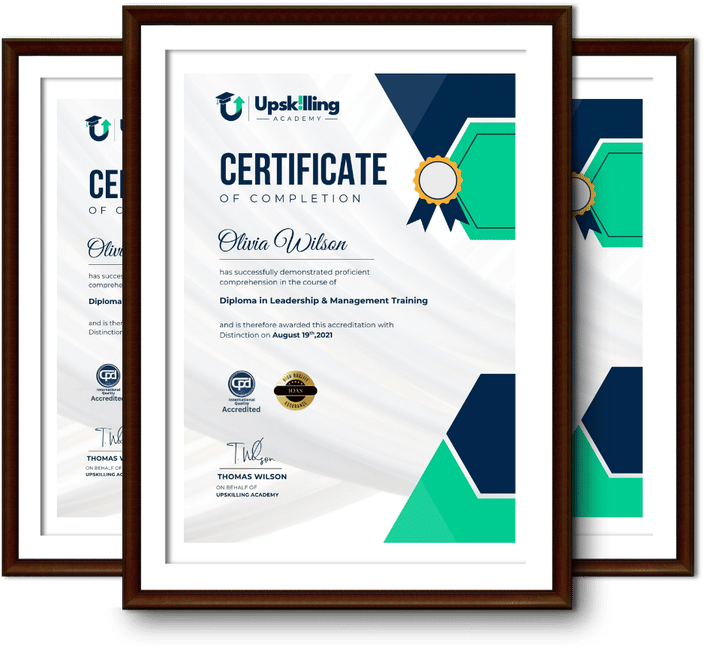
Framed Upskilling Academy certificates of completion

Course Reviews

Christine Ferguson

My experience with you was fantastic and easy to navigate. I'm looking forward to taking the course.

Jesse Harding

Provided highly informative and helpful responses, with quick and efficient replies.

Gary Schwartz

The course selection is broad, engaging, easy to follow, and offers a good challenge.

Bailey Burrows

Excellent course with user-friendly website navigation, making it easy to follow. I'm really enjoying the experience.

Benjamin Moreno

Great course with valuable information. Easy to follow, and I appreciated the flexibility to work at my own pace.

Quality Accreditation

  • incensu Registered Education Supplier
  • Association of Healthcare Trainers member
  • The CPD Group approved provider #790985
  • Disability Confident Committed

FAQ for Level 3 Certificate in AI for Finance

How do I access my course?

Once you complete your purchase, you’ll receive access to your course through your Upskilling Academy account. You can log in and access your learning materials online at any time.

How long do I have access to the course?

Your access period depends on the course and the package you purchase. Please check the course details or your order information for the applicable access period.

Can I study at my own pace?

Yes. Upskilling Academy courses are designed to provide flexible online learning, allowing you to study at a pace that suits your schedule.

Will I receive a certificate?

Certificate availability varies by course. Where a certificate is included, you’ll receive information about the requirements and how to obtain it within the course or upon completion.

Are the courses suitable for beginners?

Many courses are suitable for beginners, while others may assume some previous knowledge. Please review the individual course description for information about the recommended level and prerequisites.