Christine Ferguson
My experience with you was fantastic and easy to navigate. I'm looking forward to taking the course.
 Lifetime Access
Economics Overview Economics is the study of how societies allocate scarce resources to meet the ever-growing needs and…
Access to 1500+ Courses with free CPD Certificates for Only £99 Get Now
Economics is the study of how societies allocate scarce resources to meet the ever-growing needs and desires of individuals and groups. It encompasses the analysis of production, consumption, distribution of goods and services, and offers valuable insights into decision-making at both the micro (individual and firm) and macro (national and international) levels. This course is designed to provide students with a strong foundation in both microeconomics and macroeconomics, equipping them with analytical tools and critical thinking skills essential for understanding complex economic phenomena in a rapidly changing world. Whether you aim to pursue further studies in economics, explore a career in finance, government, or business, or simply wish to make better-informed personal and civic decisions, this course offers the core principles and applied techniques needed for success.
The Economics course offers a comprehensive guide through the foundational principles and contemporary applications of economic theory and practice. Starting with fundamental concepts such as scarcity, opportunity cost, and trade-offs, students will explore how individuals and organizations make choices within resource constraints.
The microeconomics component delves into supply and demand mechanisms, consumer and producer behavior, market structures, and the functioning of competitive and non-competitive markets. You will learn how equilibrium is established, the impact of government intervention in markets, and how market failures such as externalities and public goods shape real-world policy.
Transitioning to macroeconomics, the course examines the larger economic aggregates like national income, inflation, unemployment, and economic growth. Students will uncover the intricacies of fiscal and monetary policies, international trade, and the global economic environment. Critical issues such as inequality, globalization, technological change, and environmental challenges are considered from an economic perspective, fostering a deeper appreciation for how economics underpins societal development and policy debates.
Throughout the course, emphasis is placed on practical application and problem-solving. Students will engage with current economic debates, interpret data and graphs, and use economic models and reasoning to analyze issues encountered in everyday life and the workplace.
A grounding in economics opens up a wide array of career opportunities in various sectors. Economics graduates are in high demand owing to their analytical skills, ability to interpret data, and understanding of markets and policy. Typical career paths and industries for students completing this course include:
The versatility of an economics education also provides a strong foundation for continued studies in law, business administration, public policy, and beyond.
This course is tailored for a broad audience, reflecting the crucial role economics plays in society. Specifically, it is suitable for:
No prior background in economics is required, so the course remains accessible to motivated learners from any discipline or walk of life.
To maximize your benefit from this course, there are a few requirements and recommendations:
No previous coursework in economics is required. All essential economic concepts, tools, and frameworks will be introduced and explained from the ground up. Supplemental resources and optional advanced readings will be provided for students wishing to delve deeper into specific topics.
At the end of the course, you will have developed a sound understanding of fundamental economic principles, improved your ability to analyze economic issues, and gained practical skills applicable both in your academic pursuits and in many professional settings.
My experience with you was fantastic and easy to navigate. I'm looking forward to taking the course.
Provided highly informative and helpful responses, with quick and efficient replies.
The course selection is broad, engaging, easy to follow, and offers a good challenge.
Excellent course with user-friendly website navigation, making it easy to follow. I'm really enjoying the experience.
Great course with valuable information. Easy to follow, and I appreciated the flexibility to work at my own pace.



Once you complete your purchase, you’ll receive access to your course through your Upskilling Academy account. You can log in and access your learning materials online at any time.
Your access period depends on the course and the package you purchase. Please check the course details or your order information for the applicable access period.
Yes. Upskilling Academy courses are designed to provide flexible online learning, allowing you to study at a pace that suits your schedule.
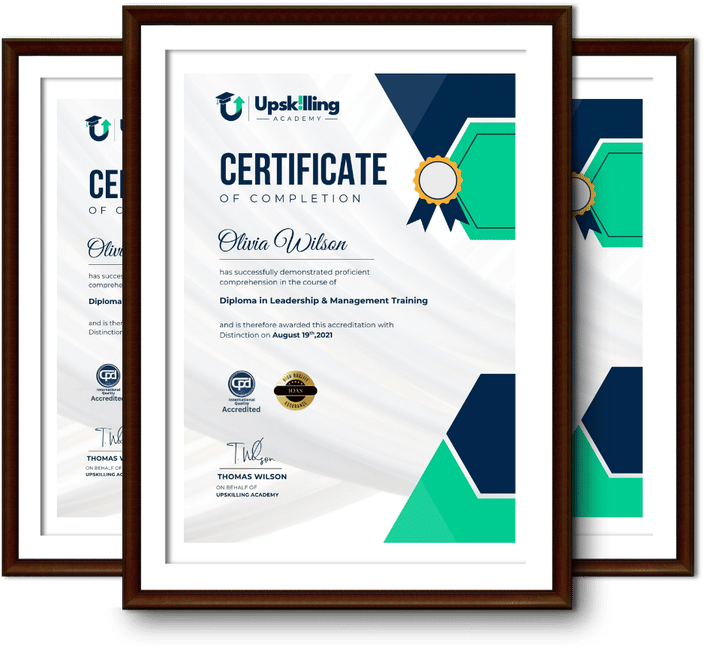
Certificate availability varies by course. Where a certificate is included, you’ll receive information about the requirements and how to obtain it within the course or upon completion.
Many courses are suitable for beginners, while others may assume some previous knowledge. Please review the individual course description for information about the recommended level and prerequisites.